Total Pageviews

Tuesday, 2 October 2012

Angkor Wat : Largest Hindu Temples in Modern Cambodia


3D Picture of Angkor Wat From http://www.devata.org/2009/08/virtual-tourists-experience-angkor-wat-in-free-3d-visit/


Khmer Empire and Angkor Wat:

Angkor the royal capital of the Khmers,


One of the most important civilization in Southeast Asia, the Khmer Empire was ruled frm the 9th to the 15th Centuries by god-like kings. They Glorified themselves and their people by their magnificent building projects. Angkor the royal capital of the Khmers, was founded in 802 by Jayavarman-II. People flocked to the city from all over the region. In the 12 th century Angkor`s Masterpiece, Angkor Wat was built. Shortly afterwards both city and temple were sacked by the Chams, but they were rebuilt by Jayavarman VII within 50 years.

3D Picture of Angkor Wat From http://www.devata.org/2009/08/virtual-tourists-experience-angkor-wat-in-free-3d-visit/

The temples of Angkor are highly symbolic structures. The foremost Hindu concept is the temple-mountain, where the temple is built as a representation of the mythical Mount Meru: this is why so many temples, including Angkor Wat itself, are surrounded by moats, built in a mountain-like pyramidal shape and topped by precisely five towers, representing the five peaks of Mount Meru. The linga (phallus), representing the god Shiva, was also critical and while the lingas themselves have largely gone, linga stands (carved, table-like blocks of stone) can be found in many if not most rooms in the temples. There was also a political element to it all: most kings wanted to build their own state temples to symbolize their kingdom and their rule.

The temples of Angkor are highly symbolic structures
 Ruins of rich Khmer civilization that dominated north-western  Cambodia and eastern Thailand for about 500 years until the 15th century .Its extensive network of temples and man made lakes and irrigation canals was discovered , hidden by centuries in Jungle undergrowth , in 1860 more than 600 Hindu Temples, some as big as Cathedrals, all with elaborately uncovered and restored.

The Elephant Terrace

The two largest complexes were at Angkor Wat meaning "Temple city"  in the Khmer Language and at Angkor Thom. At the heart f the each complex a pyramidal temple-mountain with 5 ornate. Soaring towers.The rectangular lakes reservoirs also known as barais and the network of canals functioned mainly to re-create on earth an image f the Hindu Buddhist universe.Some images of the Buddha are thought  to be portraits of Khmer Kings.
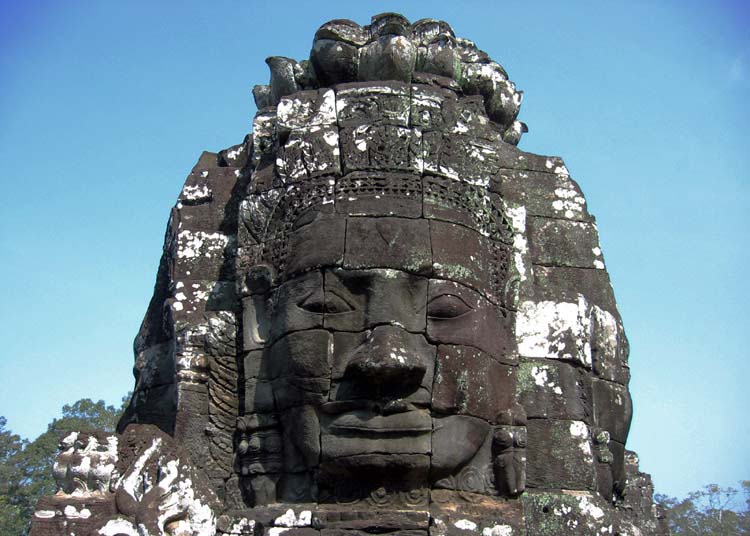
One of the 216 stone faces that adorn the towers of Bayon

The Angkor complex appears t have been abandoned by the Khmer  after the Thais attacked to Cambodia . Since 1975, when Pol Pot led the communist Takeover of the country , the Temples of Angkor , believed to be the largest  single group religious building in the world, have been inaccessible to travellers . The Jungle Has Taken over again and archaeologists fear that fast growing foliage and water erosion may have damaged the monuments.

Pre Rup, one of the many temple ruins within the Angkor Archaeological Park

The kingdoms of Khmer were under heavy Indian Influence. The Temple city of Angkor was founded in the year 900 and was the capital of huge kingdom  until the 15th century.The Khmers subjugated their neighbours in present day Thailand and Vietnam through military campaigns.The Khmer shared the predominance in south-east Asia with the Burmese and the south Vietnamese Chams.

History of Hinduism and Buddhism in Cambodia:

Buddhism entered Cambodia through two different streams. The earliest forms of Buddhism, along with Hindu influences, entered the Funan kingdom with Hindu merchants. In later history, a second stream of Buddhism entered Khmer culture during the Angkor empire when Cambodia absorbed the various Buddhist traditions of the Mon kingdoms of Dvaravati and Haripunchai.

Unconfirmed Singhalese sources assert that missionaries of King Ashoka introduced Buddhism into Southeast Asia in the 3rd century BC. Various Buddhist sects competed with Brahamanism and indigenous animistic religions over approximately the next millennium; during this period, Indian culture was highly influential

Th Funan Kingdom that flourished between 100 BC and 500 AD kingdom was Hindu, with the kings of Funan sponsoring the worship of Vishnu and Shiva. Buddhism was already present in Funan as a secondary religion in this era.Buddhism began to assert its presence from about year 450 onward, and was observed by the Chinese traveler I Ching toward the close of the seventh century.

Extent of the Empire:

Extent of the Empire:

Angkor, the capital of Khmer culture, was in present day Cambodia. At the peak of its power,the empire streached from the South China Sea to the Gulf of Siam ( Modern Thailand),and included all of what is today Cambodia, eastern Thailand Vietnam and Laos.

Religion:

Buddhist son, Jayavarman VII,


Most Khmer Kings were Hindu , therefore many of Angkor Wat`s sculptures are monuments t hindu gods. Some of The Kings were actually thought to be god-kings. The hindu Suryavarman II believed himself to be an incarnation f the Hindu god Vishnu, while his Buddhist son, Jayavarman VII, believed himself to be a reincarnation of the Buddha.

Elephants had great religious significance

The Khmer believing that Elephants had great religious significance, captured them and trained them for war service and parades. one famous regiment included around 200,000 Elephants.

Angkor Wat:

Angkor Wat is the greatest Khmer temple and was the largest religious building in the world for centuries

Angkor Wat is the greatest Khmer temple and was the largest religious building in the world for centuries. Built of Stone materials reserved for the gods - it took about 50,000 workers just over 40 years to complete in the reign of Suryavarman II (1113-50). Legend has it that the temple was nt built by humans but by the god Indra, who came to earth to create it. Reliefs include scene of Hindu Gods, the Khmer peoople at warand royal processions.

Farming:

The Khmer success was due to their agricultural sophistication.

The Khmer success was due to their agricultural sophistication. An advanced system was needed to support the large populations within the temple-places. Engineers built network of channels, which apart from containing fish also irrigated rice fields and fruit trees in the dry season, so they produced abundant harvests, because of this, the empire became the richest in South east Asia.

Bayon:


Life at court and parades are carved around the walls of the Bayon

Historical events, Life at court and parades are carved around the walls of the Bayon, the last great Khmer temple built at Angkor. Suryavarman II `s son Jayavarman VII, built the Bayon to commemorate a resounding victory over the Neighbouring Cham people, who had destroyed Angkor in 1177.

Buddhist nun. Bayon Temple, Angkor Wat, Siem Reap, Cambodia (January 2005).


Jayavarman VII :


The heroic Jayavarman

The heroic Jayavarman (1181-1219) was leader of the Khmers.After the destruction of Angkor by the Cham people, Jayavarman led a successful counter attack and encouraged his people to rebuild Angkor. During his long life he constructed a new temple, the Bayon, to commemorate his Triumphs. The massive stone faces carved on the walls of the temples represent Jayavarman and are also meant to resemble the Buddha.Jayavarman changed the Religion from Hinduism to Buddhism.

Motifs:
Apsaras


Apsara
Celestial nymphs, always bare-breasted and usually dancing, representing an ideal of female beauty.

Kala

Kala
Monstrous face without a lower jaw, often found on temple gateways, meant to guard against evil.


Naga


Naga
Many-headed mythical serpent. The most famous Nagas' in Angkor can be found on the guardrails of each entrance to Angkor Thom.

Decline:

The neighbouring Siamese (Thai) people attacked Angkor in 1431. This combined with the cost of maintaning monuments, led t the great city decline, and Angkor was abandoned shortly afterwards. Over centuries, jungle vegetation covered the temple, and Angkor became known as the " Lost Capital" . In 1862, it was rediscovered by French naturalist Henri Mouhot.

Modern Cambodia :

Modern Cambodian map


Cambodia was at the forefront of worldwide news in 1975 as Communist Khmer Rouge forces captured the capital city of Phnom Penh, and ordered the evacuation of all cities and towns. Millions of Cambodians were subsequently executed, and many more died from horrible living conditions.

In 1978, a Vietnamese invasion followed by two decades of fighting drove the Khmer Rouge out, and then in 1993, UN-sponsored elections helped restore some level of normalcy. A coalition government, formed after national elections in 1998, brought renewed political stability and the surrender of remaining Khmer Rouge forces in 1998.

The capital city of  Phnom Penh, located where the Bassac, Sab and Mekong rivers merge, is the main entry point into the country for travelers, and most tourists journey to this far-off land specifically to visit the ancient temples of Angkor Wat.

Beautiful 3D Picture of Angkor Wat From http://www.devata.org/2009/08/virtual-tourists-experience-angkor-wat-in-free-3d-visit/

Walt Disney : Father of Animation World


Virtual 3D Picture of Sir Walt Disney with his two greatest creation Micky Mouse and Donald Duck in front of their Virtual Disney-Land Castle (Imaginary) (This 3D picture created by me (Manash Kundu) in 3D-Max software


Walt Disney:

 born Dec. 5, 1901, Chicago, Ill., U.S.

died Dec. 15, 1966, Los Angeles, Calif.

U.S. animator and entertainment executive.

Photograph:Walt Disney, 1950.

 Walt Disney, 1950.

Picture of Walt Disney in front of his famous creation Micky Mouse
 In the 1920s he joined with his brother Roy and his friend Ub Iwerks (1901–71) to establish an animation studio. Together they created Mickey Mouse, the cheerful rodent—customarily drawn by Iwerks, with Disney providing the voice—that starred in the first animated film with sound, Steamboat Willie (1928). The brothers formed Walt Disney Productions (later the Disney Co.) in 1929. Mickey Mouse's instant popularity led them to invent other characters such as Donald Duck, Pluto, and Goofy and to make several short cartoon films, including The Three Little Pigs (1933). Their first full-length animated film, Snow White and the Seven Dwarfs (1937), was followed by classics such as Pinocchio (1940), Fantasia (1940), and Cinderella (1950). A perfectionist, an innovator, and a skilled businessman, Walt Disney maintained tight control over the company in both creative and business aspects. He oversaw the company's expansion into live-action films, television programming, theme parks, and mass merchandising. By his death in 1966, Disney had transformed the family entertainment industry and influenced more than one generation of American children.

Animation:

Process of giving the illusion of movement to drawings, models, or inanimate objects.

From the mid-1850s, such optical devices as the zoetrope produced the illusion of animation. Stop-action photography enabled the production of cartoon films. The innovative design and assembly techniques of Walt Disney soon moved him to the forefront of the animation industry, and he produced a series of classic animated films, beginning with Snow White and the Seven Dwarfs (1937). The Fleischer brothers and the animators at Warner Brothers offered more irreverent cartoons that often appealed to adult audiences. In Europe new animation alternatives to line drawing were developed, including animation using puppets (sometimes made from clay). In the late 20th century computer animation, as seen in the first fully computer-generated animated feature, Toy Story (1995), moved the art to a new level.

Snow White and the Seven Dwarfs


Walt_Disney_Snow_white_1937_trailer_screenshot_


Snow White and the Seven Dwarfs, the feature went into full production in 1934 and continued until mid-1937, when the studio ran out of money. To obtain the funding to complete Snow White, Disney had to show a rough cut of the motion picture to loan officers. The film premiered at the Carthay Circle Theater on December 21, 1937 and at its conclusion the audience gave Snow White and the Seven Dwarfs a standing ovation. Snow White, the first animated feature in America made in Technicolor, was released in February 1938 under a new distribution deal with RKO Radio Pictures. RKO had been the distributor for Disney cartoons in 1936, after it closed down the Van Beuren Studios in exchange for distribution.The film became the most successful motion picture of 1938 and earned over $8 million on its initial release. These initial release earnings for Snow White and the Seven Dwarfs would be the equivalent of $122,487,945 in 2010.


Disney Co.

Logo of Walt Disney Studios

U.S. entertainment corporation.

It was founded by Walt Disney and his brother Roy as Walt Disney Productions in 1929 to incorporate their cartoon animation studio. It produced short and full-length animated cartoons in the 1930s and 1940s, then expanded in the 1950s to make nature documentaries and live-action films as well as television programs. The opening of the amusement parks Disneyland (1955) and Walt Disney World (1971; see Disney World and Disneyland) strengthened the company's dominance of the family entertainment industry in the U.S. The company declined after Disney's death in 1966 but was revitalized under new management in the 1980s. As the Walt Disney Co. it expanded its production units to include Touchstone Pictures and Miramax, makers of films for more mature audiences, and revitalized its animation division, producing films such as The Little Mermaid (1989) and Toy Story (1995), the first full-length computer-animated film. The company took an active role in reviving and commercializing New York City's Times Square, including the recreation of some of its animated films, such as The Lion King (1994), as Broadway musicals. In 1994 it opened Celebration, a planned community in central Florida. It acquired the ABC television network in 1996 and became the world's largest media and entertainment corporation; it also operates the cable television Disney Channel. See also Michael Eisner.

Academy Awards

This display case in the lobby of the Walt Disney Family Museum in San Francisco shows many of the Academy Awards he won, including the distinctive special award at the bottom for Snow White and the Seven Dwarfs.

Walt Disney holds the record for both the most Academy Award nominations (59) and the number of Oscars awarded (22). He also earned four honorary Oscars. His last competitive Academy Award was posthumous.

Disney World and Disneyland:


Disneyland-Resort

Two theme parks built by the Walt Disney Co. (see Disney Co.), a U.S. corporation that became the best-known 20th-century purveyor of entertainment.


Celebration In Disney Land by all virtual cartoon characters of Disney Movies


Disneyland, an interactive, family-oriented fantasy environment that opened in Anaheim, Calif., in 1955, was Walt Disney's response to typical amusement parks, which entertained children but not their parents. The park, which has architecture that is a blend of futurism and nostalgic 19th-century reproductions, has different sections devoted to specific themes. Walt Disney World opened near Orlando, Fla., in 1971. Besides containing Epcot Center (an idealized city), Disney-MGM Studios, and the Magic Kingdom and Animal Kingdom theme parks, Disney World was the first amusement park to incorporate hotels (including two designed by Michael Graves) and sports and other recreational facilities into its master plan. In the late 20th century new Disney theme parks also opened in Paris and Tokyo.


Famous Micky and Minni Mouse In front of Disney-Land


Mickey Mouse

Mickey Mouse : Famous cartoon character of Disney (Created by me in 3D Max Software)


Famous character of Walt Disney's animated cartoons.

He was introduced in Steamboat Willie (1928), the first animated cartoon with sound. Mickey was created by Disney, who also provided his high-pitched voice, and was usually drawn by the studio's head animator, Ub Iwerks. Noted for his overlarge head and round black ears, he became the star of more than 100 cartoon shorts. The Mickey Mouse Club was one of the most popular television shows for children in the U.S. in the 1950s, and the signature black cap with mouse ears worn by the show's stars became one of the most widely distributed items in merchandising history.

Donald Duck

Donald Duck: Another Famous cartoon character of Disney (Created by me in 3D Max Software)


Donald Fauntleroy Duck is a cartoon character created in 1934 at Walt Disney Productions and licensed by The Walt Disney Company. Donald is ananthropomorphic  white duck with a yellow-orange bill, legs, and feet. He typically wears a sailor suit with a cap and a black or red bow tie. Donald is most famous for his semi-intelligible speech and his mischievous and irritable personality. Along with his friend Mickey Mouse, Donald is one of the most popular Disney characters and was included in TV Guide's list of the 50 greatest cartoon characters of all time in 2002. He has appeared in more films than any other Disney character and is the fifth most published comic book character in the world after Batman, Superman, Spider-Man, and Wolverine.

Goofy


Goofy : Another Famous cartoon character of Disney (Created by me in 3D Max Software)

Goofy is a cartoon character created in 1932 at Walt Disney Productions. Goofy is a tall, anthropomorphic dog, and typically wears a turtle neck and vest, with pants, shoes, white gloves, and a tall hat originally designed as a rumpled fedora. Goofy is a close friend of Mickey Mouse and Donald Duck and is one of Disney's most popular characters. He is normally characterized as extremely clumsy and having little intelligence, yet this interpretation isn't always definitive; occasionally Goofy is shown as intuitive and clever, albeit in his own unique, eccentric way.

Goofy debuted in animated cartoons, starting in 1932 with Mickey's Revue. During the 1930s he was used extensively as part of a comedy trio with Mickey and Donald. Starting in 1939, Goofy was given his own series of shorts which were popular in the 1940s and early '50s. He also co-starred in a short series with Donald. Four more Goofy shorts were produced in the 1960s after which Goofy was only seen in television and comics. He returned to theatrical animation in 1983 with Mickey's Christmas Carol. His last theatrical appearance was How to Hook Up Your Home Theater in 2007. Goofy has also been featured in television, most extensively in Goof Troop (1992–1993), as well as House of Mouse (2001–2003) and Mickey Mouse Clubhouse (2006–present).


Famous  Three Characters (Goofy, Micky Mouse and Donald Duck created by Manash Kundu) of Walt Disney


Pixer Acquisition by Disney

John Lasseter appears with characters from Up at the 2009 Venice Film Festival.
 Disney announced on January 24, 2006 that it had agreed to buy Pixar for approximately $7.4 billion in an all-stock deal. Following Pixar shareholder approval, the acquisition was completed May 5, 2006. The transaction catapulted Steve Jobs, who was the majority shareholder of Pixar with 50.1%, to Disney's largest individual shareholder with 7% and a new seat on its board of directors. Jobs' new Disney holdings exceeded holdings belonging to ex-CEO Michael Eisner, the previous top shareholder, who still held 1.7%; and Disney Director Emeritus Roy E. Disney, who held almost 1% of the corporation's shares.

Pixar shareholders received 2.3 shares of Disney common stock for each share of Pixar common stock redeemed.


Buzz Lightyear: Character From Toy-Story Movies from Pixar released by Walt Disney Pictures (this Picture Created by me in 3d Max)

As part of the deal, John Lasseter, by then Executive Vice President, became Chief Creative Officer (reporting to President and CEO Robert Iger and consulting with Disney Director Roy Disney) of both Pixar and the Walt Disney Animation Studios, as well as the Principal Creative Adviser at Walt Disney Imagineering, which designs and builds the company's theme parks. Catmull retained his position as President of Pixar, while also becoming President of Walt Disney Animation Studios, reporting to Bob Iger and Dick Cook, chairman of Walt Disney Studio Entertainment. Steve Jobs' position as Pixar's Chairman and Chief Executive Officer was also removed, and instead he took a place on the Disney board of directors.

Virtual 3D Picture of Sir Walt Disney with his two greatest creation Micky Mouse and Donald Duck in front of their Virtual Disney-Land Castle (Imaginary) (This 3D picture created by me (Manash Kundu) in 3D-Max software

Famous  Three Characters (Goofy, Micky Mouse and Donald Duck created by Manash Kundu) of Walt Disney

Monday, 1 October 2012

Mohandas Karamchand Gandhi: Rediscovering the Power of Ahimsha (Non-Violence) to the World as a Father of Indian Nation


3D Picture of Gandhiji created by me (Manash Kundu)


Mohandas Karamchand Gandhi:


Mohandas Karamchand Gandhi  ( 2 October 1869– 30 January 1948)


Mohandas Karamchand Gandhi  ( 2 October 1869– 30 January 1948), commonly known as Mahatma Gandhi, was the preeminent leader of Indian nationalism in British-ruled India. Employing non-violent civil disobedience, Gandhi led India to independence and inspired movements for non-violence, civil rights and freedom across the world.

The son of a senior government official, Gandhi was born and raised in a Hindu Bania community in coastal Gujarat, and trained in law in London. Gandhi became famous by fighting for the civil rights of Muslim and Hindu Indians in South Africa, using the new techniques of non-violent civil disobedience that he developed. Returning to India in 1915, he set about organising peasants to protest excessive land-taxes. A lifelong opponent of "communalism" (i.e. basing politics on religion) he reached out widely to all religious groups. He became a leader of Muslims protesting the declining status of the Caliphate. Assuming leadership of the Indian National Congress in 1921, Gandhi led nationwide campaigns for easing poverty, expanding women's rights, building religious and ethnic amity, ending untouchability, increasing economic self-reliance, and above all for achieving Swaraj—the independence of India from British domination.


3D Picture of Gandhiji created by me (Manash Kundu)


Gandhi led Indians in protesting the national salt tax with the 400 km (250 mi) Dandi Salt March in 1930, and later in demanding the British to immediately Quit India in 1942, during World War II. He was imprisoned for that and for numerous other political offenses over the years. Gandhi sought to practice non-violence and truth in all situations, and advocated that others do the same. He saw the villages as the core of the true India and promoted self-sufficiency; he did not support the industrialization programs of his disciple Jawaharlal Nehru. He lived modestly in a self-sufficient residential community and wore the traditional Indian dhoti and shawl, woven with yarn he had hand spun on a charkha. His chief political enemy in Britain was Winston Churchill,who ridiculed him as a "half-naked fakir." He was a dedicated vegetarian, and undertook long fasts as means of both self-purification and political mobilization.

In his last year, unhappy at the partition of India, Gandhi worked to stop the carnage between Muslims on the one hand and Hindus and Sikhs that raged in the border area between India and Pakistan. He was assassinated on 30 January 1948 by a Hindu nationalist who thought Gandhi was too sympathetic to India's Muslims. 30 January is observed as Martyrs' Day in India. The honorific Mahatma ("Great Soul"), was applied to him by 1914. In India he was also called Bapu ("Father"). He is known in India as the Father of the Nation; his birthday, 2 October, is commemorated there as Gandhi Jayanti, a national holiday, and world-wide as the International Day of Non-Violence. Gandhi's philosophy was not theoretical but one of pragmatism, that is, practicing his principles in real time. Asked to give a message to the people, he would respond, "My life is my message.

From His extraordinary autobiography, The Story of My Experiments with Truth:


His extraordinary autobiography, The Story of My Experiments with Truth


Gandhi later recorded the early years of his life in his extraordinary autobiography, The Story of My Experiments with Truth. His father died before Gandhi could finish his schooling, and at thirteen he was married to Kasturba [or Kasturbai], who was of the same age as Mohandas himself . In 1888 Gandhi set sail for England, where he had decided to pursue a degree in law. Though his elders objected, Gandhi could not be prevented from leaving; and it is said that his mother, a devout woman, made him promise that he would keep away from wine, women, and meat during his stay abroad. Gandhi left behind his son Harilal, then a few months old.

In London, Gandhi encountered theosophists, vegetarians, and others who were disenchanted not only with industrialism, but with the legacy of Enlightenment thought. They themselves represented the fringe elements of English society. Gandhi was powerfully attracted to them, as he was to the texts of the major religious traditions; and ironically it is in London that he was introduced to the Bhagavad Gita. Here, too, Gandhi showed determination and single-minded pursuit of his purpose, and accomplished his objective of finishing his degree from the Inner Temple. He was called to the bar in 1891, and even enrolled in the High Court of London; but later that year he left for India.


Gandhiji in South Africa:


Gandhiji in South Africa


After one year of a none too successful law practice, Gandhi decided to accept an offer from an Indian businessman in South Africa, Dada Abdulla, to join him as a legal adviser. Unbeknown to him, this was to become an exceedingly lengthy stay, and altogether Gandhi was to stay in South Africa for over twenty years. The Indians who had been living in South Africa were without political rights, and were generally known by the derogatory name of 'coolies'. 

Gandhi decided to accept an offer from an Indian businessman in South Africa, Dada Abdulla, to join him as a legal adviser


Gandhi himself came to an awareness of the frightening force and fury of European racism, and how far Indians were from being considered full human beings, when he when thrown out of a first-class railway compartment car, though he held a first-class ticket, at Pietermaritzburg. From this political awakening Gandhi was to emerge as the leader of the Indian community, and it is in South Africa that he first coined the term satyagraha to signify his theory and practice of non-violent resistance. Gandhi was to describe himself preeminently as a votary or seeker of satya (truth), which could not be attained other than through ahimsa (non-violence, love) and brahmacharya (celibacy, striving towards God). Gandhi conceived of his own life as a series of experiments to forge the use of satyagraha in such a manner as to make the oppressor and the oppressed alike recognize their common bonding and humanity: as he recognized, freedom is only freedom when it is indivisible. In his book Satyagraha in South Africa he was to detail the struggles of the Indians to claim their rights, and their resistance to oppressive legislation and executive measures, such as the imposition of a poll tax on them, or the declaration by the government that all non-Christian marriages were to be construed as invalid. In 1909, on a trip back to India, Gandhi authored a short treatise entitled Hind Swaraj or Indian Home Rule, where he all but initiated the critique, not only of industrial civilization, but of modernity in all its aspects.

Gandhiji Became Mahatma (Great Soul) during freedom struggle of  India:

Gandhi returned to India in early 1915, and was never to leave the country again except for a short trip that took him to Europe in 1931. Though he was not completely unknown in India, Gandhi followed the advice of his political mentor, Gokhale, and took it upon himself to acquire a familiarity with Indian conditions. He traveled widely for one year. 


Gandhiji at Champaran in Bihar,


Over the next few years, he was to become involved in numerous local struggles, such as at Champaran in Bihar, where workers on indigo plantations complained of oppressive working conditions, and at Ahmedabad, where a dispute had broken out between management and workers at textile mills. His interventions earned Gandhi a considerable reputation, and his rapid ascendancy to the helm of nationalist politics is signified by his leadership of the opposition to repressive legislation (known as the "Rowlatt Acts") in 1919. 

Gandhiji With Rabindranath Tagore


His saintliness was not uncommon, except in someone like him who immersed himself in politics, and by this time he had earned from no less a person than Rabindranath Tagore, India's most well-known writer, the title of Mahatma, or 'Great Soul'. 


Non-cooperation movement, which called upon Indians to withdraw from British institutions,


When 'disturbances' broke out in the Punjab, leading to the massacre of a large crowd of unarmed Indians at the Jallianwala Bagh in Amritsar and other atrocities, Gandhi wrote the report of the Punjab Congress Inquiry Committee. Over the next two years, Gandhi initiated the non-cooperation movement, which called upon Indians to withdraw from British institutions, to return honors conferred by the British, and to learn the art of self-reliance; though the British administration was at places paralyzed, the movement was suspended in February 1922 when a score of Indian policemen were brutally killed by a large crowd at Chauri Chaura, a small market town in the United Provinces. Gandhi himself was arrested shortly thereafter, tried on charges of sedition, and sentenced to imprisonment for six years. At The Great Trial, as it is known to his biographers, Gandhi delivered a masterful indictment of British rule.


Gandhiji`s Movement for  National Unity:

Owing to his poor health, Gandhi was released from prison in 1925. Over the following years, he worked hard to preserve Hindu-Muslim relations, and in 1924 he observed, from his prison cell, a 21-day fast when Hindu-Muslim riots broke out at Kohat, a military barracks on the Northwest Frontier. This was to be of his many major public fasts, and in 1932 he was to commence the so-called Epic Fast unto death, since he thought of "separate electorates" for the oppressed class of what were then called untouchables (or Harijans in Gandhi's vocabulary, and dalits in today's language) as a retrograde measure meant to produce permanent divisions within Hindu society. 


Gandhi earned the hostility of Ambedkar, the leader of the untouchables


Gandhi earned the hostility of Ambedkar, the leader of the untouchables, but few doubted that Gandhi was genuinely interested in removing the serious disabilities from which they suffered, just as no one doubt that Gandhi never accepted the argument that Hindus and Muslims constituted two separate elements in Indian society. These were some of the concerns most prominent in Gandhi's mind, but he was also to initiate a constructive programme for social reform. Gandhi had ideas -- mostly sound -- on every subject, from hygiene and nutrition to education and labor, and he relentlessly pursued his ideas in one of the many newspapers which he founded. Indeed, were Gandhi known for nothing else in India, he would still be remembered as one of the principal figures in the history of Indian journalism.

Gandhiji`s Dandi Salt Movement:

In early 1930, as the nationalist movement was revived, the Indian National Congress, the preeminent body of nationalist opinion, declared that it would now be satisfied with nothing short of complete independence (purna swaraj). Once the clarion call had been issued, it was perforce necessary to launch a movement of resistance against British rule. On March 2, Gandhi addressed a letter to the Viceroy, Lord Irwin, informing him that unless Indian demands were met, he would be compelled to break the "salt laws". 


Gandhiji`s Dandi Salt Movement


Predictably, his letter was received with bewildered amusement, and accordingly Gandhi set off, on the early morning of March 12, with a small group of followers towards Dandi on the sea. They arrived there on April 5th: Gandhi picked up a small lump of natural salt, and so gave the signal to hundreds of thousands of people to similarly defy the law, since the British exercised a monopoly on the production and sale of salt. 

Gandhiji`s Dandi Salt Movement


This was the beginning of the civil disobedience movement: Gandhi himself was arrested, and thousands of others were also hauled into jail. It is to break this deadlock that Irwin agreed to hold talks with Gandhi, and subsequently the British agreed to hold a Round Table Conference in London to negotiate the possible terms of Indian independence. Gandhi went to London in 1931 and met some of his admirers in Europe, but the negotiations proved inconclusive. On his return to India, he was once again arrested.


constructive reform of Indian society:

For the next few years, Gandhi would be engaged mainly in the constructive reform of Indian society. 


abarmati Ashram in Ahmedabad


He had vowed upon undertaking the salt march that he would not return to Sabarmati Ashram in Ahmedabad, where he had made his home, if India did not attain its independence, and in the mid-1930s he established himself in a remote village, in the dead center of India, by the name of Segaon [known as Sevagram]. It is to this obscure village, which was without electricity or running water, that India's political leaders made their way to engage in discussions with Gandhi about the future of the independence movement, and it is here that he received visitors such as Margaret Sanger, the well-known American proponent of birth-control. Gandhi also continued to travel throughout the country, taking him wherever his services were required.

Ideological Difference With Netaji Subhas Chandra Bose:


Gandhiji with Netaji


One such visit was to the Northwest Frontier, where he had in the imposing Pathan, Khan Abdul Ghaffar Khan (known by the endearing term of "Frontier Gandhi", and at other times as Badshah [King] Khan), a fervent disciple. At the outset of World War II, Gandhi and the Congress leadership assumed a position of neutrality: while clearly critical of fascism, they could not find it in themselves to support British imperialism. Gandhi was opposed by Subhas Chandra Bose, who had served as President of the Congress, and who took to the view that Britain's moment of weakness was India's moment of opportunity. When Bose ran for President of the Congress against Gandhi's wishes and triumphed against Gandhi's own candidate, he found that Gandhi still exercised influence over the Congress Working Committee, and that it was near impossible to run the Congress if the cooperation of Gandhi and his followers could not be procured. Bose tendered his resignation, and shortly thereafter was to make a dramatic escape from India to find support among the Japanese and the Nazis for his plans to liberate India.

Gandhi's Call for Quit India:


Gandhi's Call for Quit India


Sir Stafford Cripps left the country amidst unprecedented excitement. Immediately after the return of Sir Stafford Cripps, Gandhi announced 'Quit India' as the war cry for the Indians. To quote Gandhi, "The presence of the British in India is an invitation to Japan to invade India. Their withdrawal removes that bait............". Gandhi realized that the time was ripe to take some strong and quick actions. He wrote a series of articles in Harijan where he urged the people to rise in action. He was in favor of resorting to direct action. In order to give effect to the Mahatma's views, The Congress Working Committee adopted the well known 'Quit India' Resolution, on July 14th 1942 at Wardha. The All India Congress Committee accepted this resolution with some modifications, on 8th August, 1942 in Bombay.


9th August, eminent Congress leaders like Mahatma Gandhi, Vallabhbhai Patel, Jawarharlal Nehru and Abul Kalam Azad were arrested


The very next day, on 9th August, eminent Congress leaders like Mahatma Gandhi, Vallabhbhai Patel, Jawarharlal Nehru and Abul Kalam Azad were arrested. The masses were left without any guidance. Gandhi's 'do or die' call for the people created an upheaval in the country. But at the same time, Gandhi mentioned specifically that mass movement should be conducted following non violent means. The Viceroy, Lord Linlithgow, adopted a policy of harsh repression all over the country and gory instances of British atrocities abounded all over. This ruined the atmosphere of non violence in the country. Unlike the other two movements, the Non-Co-Operation and the Civil Disobedience Movement that unleashed under the aegis of Mahatma Gandhi, the Quit India Movement captures the quintessence of a 'spontaneous' rising by the people.

The Quit India Movement, inaugurated at the call of the Mahatma, unfolded in four phases. In the first phase there were strikes, processions, demonstrations and processions. This phase lasted for a period of three to four days and commenced from the day of Gandhi's arrest on August 9th , 1942. The factory and mill workers rose to the cause and displayed maximum vigor and enthusiasm. The government took recourse to repressive measures to subdue the movement. In an incident of open fire in Bombay, the casualties included large number of women and children.

Raids of municipal and government buildings characterized the second phase of the movement. Police stations, post offices and railway stations were attacked and set ablaze. Attempts were made by the agitated mobs to capture court buildings. Troops fired to control mob fury. September 1942, marks the beginning of the third phase of the movement. It is said that during this phase of the movement, the mob threw bombs on the police in Madhya Pradesh, Bombay and Uttar Pradesh. With the emergence of the movement into the fourth phase, it gained back its peaceful character and extended till Mahatma Gandhi was released from prison in May, 1944.

Quit India movement was Gandhi's final bid to secure India's independence. Although, many diverse political ideologies crowded the scenario of Indian National Movement at that time, yet it was the satyagraha adopted by Gandhi that finally had the most telling effect in challenging the British authorities. India was at the very threshold of Independence by the end of the Quit India movement and Gandhi's long cherished dream was about to be realized. Quit India movement sealed the success for satyagraha as a policy of political resistance, and Gandhi's role as the chief moving force behind India's Independence came to be universally accepted, although dark clouds of a communal fissure still lurked in the background.

Death:

Mohandas Karamchand Gandhi (often called Mahatma Gandhi) was assassinated on 30 January 1948, shot at point-blank range by Nathuram Godse. Prior to his death, there had been five unsuccessful attempts to kill Gandhi, the first occurring in 1934. Gandhi was outside on the steps of a building where a prayer meeting was going to take place. He was surrounded by a part of his family and some followers when three gunshots killed him.


Mohandas Karamchand Gandhi (often called Mahatma Gandhi) was assassinated on 30 January 1948, shot at point-blank range by Nathuram Godse


Day of assassination

Godse killed Gandhi on January 30, 1948. He approached Gandhi on the way to a prayer meeting and bowed. A girl accompanying Gandhi told Godse, "Brother, Bapu is already late" and tried to put him off, but Godse pushed her aside and shot Gandhi three times at point-blank range in the chest with a .38 Beretta semi-automatic pistol.

Gandhi's last words

The First Information Report (FIR) filed by Shri Nand Lal Mehta shows that the last words of Gandhi were Hey Raam. There has been no explanation of why he was not rushed to the hospital and was instead taken to Birla House, where he later died


3D Picture of Gandhiji and Charkha created by me (Mansh Kundu)


The Gandhian concept of the charkha:

The Gandhian concept of the charkha was a symbol of self-entrepreneurship, which alone can help the nation protect its bio-diversity and provide sustenance to the poorest of the poor

Today, when everything is creating disillusionment, people are being drawn to violence. Only Gandhian thoughts can equip the present and the future generations to deal with it without committing violence on themselves.

Gandhi picked the charkha (spinning wheel) because the British colonial rule was wiping out India's textile production. Today's colonization is around patenting of life, genetic manipulation of food, monopolies over water, seeds, plants and animals.


3D Picture of Gandhiji and Charkha created by me (Mansh Kundu)


Organic farming as a nonviolent system:

The present model of development is based on taking away the little the poor have for consumption of the rich. There is a new project sponsored by a multinational, Swayze, to cater to the wasteful needs of Delhi's public.

About 650 million litres of water will be diverted to Delhi through giant-sized pipelines, while thousands of people are being drowned at Tehri and an equal number of farmers in western Uttar Pradesh lose their crops.

So you wipe out the civilisation that has existed for ten thousand years so that for two years Delhites can wash three more cars and flush their toilets!

So, the choice for these people is not between self-reliance and development. It is self-reliance or annihilation. I believe everyone has a right to live.

Gandhi's diet was based on a principle that is good for the soil, the producer and the consumer. It produces sustainability and livelihood and is good for health.

A violent diet destroys the bio-diversity and uproots the farmers. Gandhi had a clear criteria on testing technology and it can be referred to his talisman that anyone who ignores the general masses is not technologically progressive, but humanly regressive.

What is called the economics of abundance is economics of scarcity. The Green Revolution was supposed to create abundance but has destroyed one-third of the land in Punjab. It has destroyed the water resources and wiped off thousands of farmers.

The 'economy of scarcity' is an economy viewed from the blinkers of the monoculture mind who only see what the rich and the powerful can extract. They do not see the wealth in the eco-system.

Gandhi encouraged self-entrepreneurship. Navdanya promotes it. We work with farmers to acquaint them with bio-diversity. This generates better income, because of diversity of crops.


Poster of Gandhi (film)


Gandhi (film):

Gandhi is a 1982 biographical film based on the life of Mohandas Karamchand Gandhi, who led the nonviolent resistance movement against British colonial rule in India during the first half of the 20th century. The film was directed and produced by Sir Richard Attenborough and stars Ben Kingsley as Gandhi. They both won Academy Awards for their work on the film, and the film also won the award for Best Picture, winning eight Academy Awards in total.

It was an international co-production between production companies in India and the UK. The film premiered in New Delhi on 30 November 1982.


Gandhi`s Famous Quotation


Gandhi`s Famous Quotation:

"I will give you a talisman. Whenever you are in doubt, or when the self becomes too much with you, apply the following test. Recall the face of the poorest and the weakest man [woman] whom you may have seen, and ask yourself, if the step you contemplate is going to be of any use to him [her]. Will he [she] gain anything by it? Will it restore him [her] to a control over his [her] own life and destiny? In other words, will it lead to swaraj [freedom] for the hungry and spiritually starving millions?
Then you will find your doubts and your self melt away."

 GANDHI'S FAVORITE BHAJAN:


 Vaishnov Jan to taynay kahyeeye
Jay peerh paraaye janneyray
Par dukkhey upkar karey teeyey,
man abhiman na anney ray

Sakal lokma Sahuney bandhey,
Ninda Na karye kainee ray
Baach kaachh, Man nischal Raakhey,
dhan-dhan jananee tainee ray

Samdrishi nay trishna tyagee,
par-stree jaynay mat ray
Vivihva thaki asatya na bolay,
par-dhan nav jhaley haath ray

Moh maaya vyaayey nahin Jeynay,
dridth vairagya jana manma ray
Ram-nam-shoom taalee laagee,
Sakal teerth seyna tanma ray

Vanloohee nay kapat rahit chhay,
Kaam, Krodh nivarya ray
Bhane Narsinhyo tainoo darshan karta
kul ekotair taarya re.


3D Picture of Gandhiji created by me (Manash Kundu)


3D Picture of Gandhiji and Charkha created by me (Mansh Kundu)